Sustainable living at home · Bedding
How Organic Linen Shapes a More Breathable Bed
A bed’s comfort is not always a matter of softness. Sometimes it is a matter of air: how readily a fabric lets warmth escape, how it handles moisture, and whether its texture feels pleasant after the hundredth wash. Organic linen brings those questions into focus, combining a characteristic lightness with a fiber built for long use.
Published November 18, 2026
There is a particular quietness to a linen bed. The fabric does not lie perfectly flat, nor does it seem especially interested in doing so. Its surface carries small irregularities; its folds catch the light unevenly. What might be called rumpling in another textile can look, in linen, like evidence of a life being lived. The bed has been slept in. The sheets have been washed. The room has not been arranged solely for inspection.
That ease is more than an aesthetic effect. Linen’s fiber, weave, weight, and finish all contribute to how it feels in daily use. A breathable bed is not made by one magic label or a single number on a specification sheet. It is the result of choices: what the fabric is made from, how it is constructed, how it suits the room’s climate, and whether its care instructions fit the household that will use it.
Organic linen bedding is therefore worth considering as a material, not merely as a style. The term “organic” speaks to the way the flax crop is grown and certified; it does not, by itself, promise a particular softness, weight, or level of airflow. Those qualities depend on the finished textile. Looking closely at fiber origin, fabric weight, and care can help distinguish a useful everyday sheet from a persuasive description.
What makes linen feel breathable?
Linen is made from flax. The resulting yarn can be woven into fabric with a dry, textured hand and a drape that tends to feel less close to the skin than some denser textiles. That impression matters in bed, where warmth and moisture accumulate over hours. A breathable fabric allows air to move through its structure and can help moisture disperse, contributing to a more comfortable sleep environment.
Breathability is not a guarantee that linen will keep every sleeper cool in every condition. Room temperature, humidity, mattress construction, blankets, sleepwear, and individual comfort all play a part. A heavy quilt over a sheet can retain warmth regardless of the fiber beneath it. Linen is better understood as one element in a bedding system, rather than a substitute for sensible layering or ventilation.
Its texture also influences the experience. Linen may feel crisp at first, particularly when newly laundered, then soften through use and washing. The surface is not necessarily smooth in the polished, uniform sense. Slubs and small variations in yarn are part of the fabric’s character, not automatically signs of poor quality. For someone accustomed to very smooth cotton, that natural irregularity may be noticeable; for another sleeper, it is precisely what makes the bed feel relaxed.
Construction matters as much as fiber. Weave, yarn size, and finishing determine how open or compact a cloth feels, how it drapes, and how much substance it has. A light linen sheet can feel airy and fluid; a heavier one may have more presence and a slower, weightier fall. Neither is inherently superior. The right choice depends on whether the priority is a delicate layer, a substantial hand, or a balance between the two.
Organic is a growing claim, not a comfort rating
When a product is described as organic linen, the claim concerns the agricultural and certification context of its fiber. It should not be treated as shorthand for “chemical-free,” “environmentally perfect,” or “automatically more comfortable.” The precise meaning depends on the applicable standard and the documentation behind the claim. A careful reader looks for clear wording about the material and, where relevant, the certification rather than relying on a green-sounding adjective alone.
Organic linen can still vary in weight, weave, finish, and origin. Two sheets made from organic flax may feel quite different once woven and finished. Likewise, a label that identifies a textile as linen does not necessarily explain where the flax was grown or where the fabric was woven. These are separate details, and transparent product information should make them easier to distinguish.
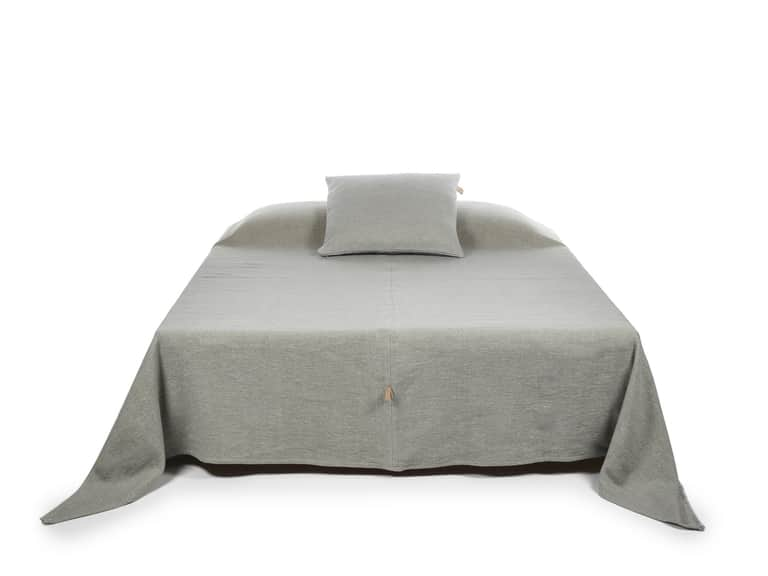
Libeco’s Heritage bedding provides one example of how such details can be presented. Its Heritage flatsheet is described as 100% organic linen, woven in Belgium with European flax yarn, at a fabric weight of 5.6 ounces per square yard, or 190 grams per square metre. That information does not tell every sleeper exactly how the sheet will feel, but it gives a more concrete basis for comparison than a broad promise of luxury. The Heritage organic linen flatsheet is described as having a crisp, breathable character and a natural drape.
The Heritage duvet cover is also listed as 100% organic linen, with the same stated weight of 5.6 ounces per square yard. Its care guidance recommends washing at up to 40°C with mild soap, avoiding chlorine bleach, and line drying where possible. These details are practical rather than poetic, and that is their virtue: they help a household judge whether the fabric and its upkeep belong in its ordinary routine. The Heritage organic linen duvet cover illustrates how fiber content, weight, and care can be read together.
Reading fabric weight without overreading it
Fabric weight is useful, but it is not a simple ranking system. It describes the mass of a given area of fabric; it does not, on its own, measure softness, durability, quality, or breathability. A heavier textile may feel more substantial and drape differently, while a lighter one may suit warm weather or a preference for a less enveloping layer. The weave and finishing still shape the final result.
For comparison, the Heritage linen bedding described above weighs 5.6 ounces per square yard. A Madison flatsheet is listed at 5.5 ounces per square yard, or 175 grams per square metre, and is described as 100% linen with a washed finish. The figures are close, but the products are not identical: one is specified as organic linen, while the other’s supplied description emphasizes its washed finish and Belgian Linen label. A shopper should not infer that neighboring weights will feel indistinguishable, or that the number alone resolves the choice.
When comparing labels, make sure units are consistent. Some descriptions use ounces per square yard; others use grams per square metre. Both can be helpful if clearly stated, but comparing the figures without conversion can create a false impression. If a product page omits weight, that omission need not be disqualifying. It simply means other information—composition, weave description, finish, origin, and return or care policies—will carry more of the decision.
It is also useful to separate sheet weight from the weight of a blanket or coverlet. A linen-wool coverlet, for instance, is designed as an additional layer, not as a close-fitting sheet. The Shetland Coverlet is described as a washed blend of 70% linen and 30% wool, weighing 18 ounces per square yard. Its composition and weight make it a different proposition from a lightweight organic linen sheet: a warm, textural layer for the bed rather than the fabric immediately against the sleeper.
Origin, labels, and the value of specificity
Origin language can answer several distinct questions. Where was the flax grown? Where was the yarn spun? Where was the fabric woven? Where was the finished bedding assembled? These stages may take place in different locations, so a concise phrase such as “European linen” may be informative without telling the whole story.
The Heritage descriptions identify European flax yarn and Belgian weaving. A Belgian Linen label, where stated, is a clue about the textile’s connection to Belgian weaving and European flax yarn, not a universal certification of environmental impact. Labels are most useful when their scope is understood. They can help establish provenance, but they do not replace an explanation of composition, processing, or care.
Such specificity is valuable partly because linen’s environmental story is not reducible to one word. Agricultural practices, water and energy use, dyeing and finishing, transport, durability, and the number of years a textile remains in service all matter. A responsibly grown fiber may be a meaningful attribute, but claims about a product’s total impact require evidence across its life cycle. Avoiding extravagant assumptions is not cynicism; it is a way to make sustainability information more trustworthy.
Durability belongs in the same discussion. A sheet that is used for years may offer more practical value than one replaced frequently, though lifespan depends on construction, laundering, and how a household uses it. Linen is known for strength as a fiber, but no fabric is indestructible. Seams, hems, fit, washing habits, and drying methods all influence how bedding holds up. Good material information helps set expectations; it cannot eliminate ordinary wear.
Care that preserves the fabric
Care instructions are not a footnote to comfort. They determine whether a textile is easy to live with. Linen generally benefits from washing that is neither unnecessarily harsh nor overloaded with other laundry. Mild detergent, an appropriate cycle, and enough space for the fabric to move can help avoid excessive abrasion. The product’s own instructions should take precedence, since finishes and blends may call for different treatment.
For the Heritage linen pieces, the stated guidance is to wash at a maximum of 40°C with mild soap, avoid chlorine bleach, and line dry if possible. If using a tumble dryer, the descriptions advise medium heat and avoiding overdrying. Steam ironing while the linen is slightly damp can help smooth the fabric, although ironing is a preference rather than a requirement for a relaxed linen bed.
Natural wrinkles are part of linen’s familiar appearance. Pressing every crease flat may suit a formal room, but it is not necessary for the fabric to function well. Many people prefer to let the sheet keep its softened, lived-in surface. This choice can simplify care, though it should not be confused with skipping laundering or ignoring the specific instructions attached to the textile.
Blended pieces need additional attention. The Shetland Coverlet’s linen-wool composition, for example, comes with guidance to wash at no more than 30°C on a wool or hand-wash program, use mild soap, unfold it before washing, and line dry if possible. Wool changes the care equation, so instructions for a pure linen sheet should not simply be transferred to a linen-wool layer. This is one reason composition deserves a place near the top of any product description.
Choosing sheets for your room and routine
Begin with the conditions in which the bedding will be used. A warm bedroom, a naturally hot sleeper, or frequent summer use may make a light, breathable sheet especially appealing. In a cool room, or for someone who likes a more substantial feel, a mid-weight linen or additional layers may be preferable. There is no universally correct fabric weight because comfort is personal and seasonal.
Next, consider the bedding arrangement. A flat sheet can provide a flexible layer between the sleeper and duvet; a fitted sheet needs to match the mattress dimensions and depth; a duvet cover should fit the insert closely enough to stay in place without straining the seams. Pillowcases should accommodate the pillow without excessive bunching. Product listings do not always provide every dimension in a short description, so checking the full sizing information before buying is sensible.
For a coordinated bed, consistency does not require every piece to be identical. A plain organic linen sheet can sit comfortably beside a subtly striped coverlet, or a washed coverlet can bring texture to a smoother duvet cover. What matters is that the layers work together in weight and care. A delicate sheet paired with a bulky layer that demands a very different laundry routine may be perfectly usable, but it is worth knowing that before the first wash.
Finally, ask whether the fabric’s character suits your preferences. Linen is not a clever disguise for cotton, nor is it universally softer at the outset. Its appeal often lies in a combination of airiness, texture, and a tendency to become more yielding with regular use. If a perfectly smooth surface is essential, another material may better match the expectation. If natural variation and a gently rumpled finish feel welcoming, linen may be a good fit.
A practical checklist for organic linen bedding
- Check the composition. Confirm whether the item is 100% linen or a blend, and note any wool or other fibers that may change its feel and care.
- Read the organic claim precisely. Look for clear material language and certification details where applicable; do not assume the word alone describes every stage of production.
- Look for origin information. Distinguish flax origin, yarn origin, and weaving location when those details are provided.
- Use fabric weight as context. Compare like units, but treat weight as one clue among weave, finish, and construction—not a quality score.
- Match the piece to its role. Sheets and duvet covers sit close to the body; coverlets are layering pieces and may be substantially heavier.
- Check dimensions and construction. Verify mattress depth, duvet size, pillow fit, hems, seams, and closure details before building a set.
- Make care part of the decision. Washing temperature, drying method, and bleach guidance should be realistic for your household.
- Allow for natural variation. Linen’s texture and slight irregularities are part of its character; they are not necessarily defects.
A more considered kind of comfort
The best bedding is not always the bedding that makes the most emphatic claim. It is the bedding whose material, weight, and upkeep make sense once the room is dark and the day is over. Organic linen offers a compelling combination: a breathable, textured fabric; the possibility of durable everyday use; and, when clearly documented, information about fiber and production that helps a reader make a more considered choice.
Libeco’s Heritage flatsheet and duvet cover show how useful such details can be when they appear together: organic linen composition, European flax yarn, Belgian weaving, stated fabric weight, and specific washing guidance. They do not settle every question of comfort or environmental impact. They do, however, make the questions easier to ask.
A breathable bed is ultimately a practical arrangement, not a slogan. Choose layers that suit the climate, look beyond softness to construction and care, and give the fabric room to become familiar through use. Linen’s quiet gift may be that it does not insist on looking untouched. It asks only to be lived with—and, now and then, washed with a little attention.

